By J.E. McKeever
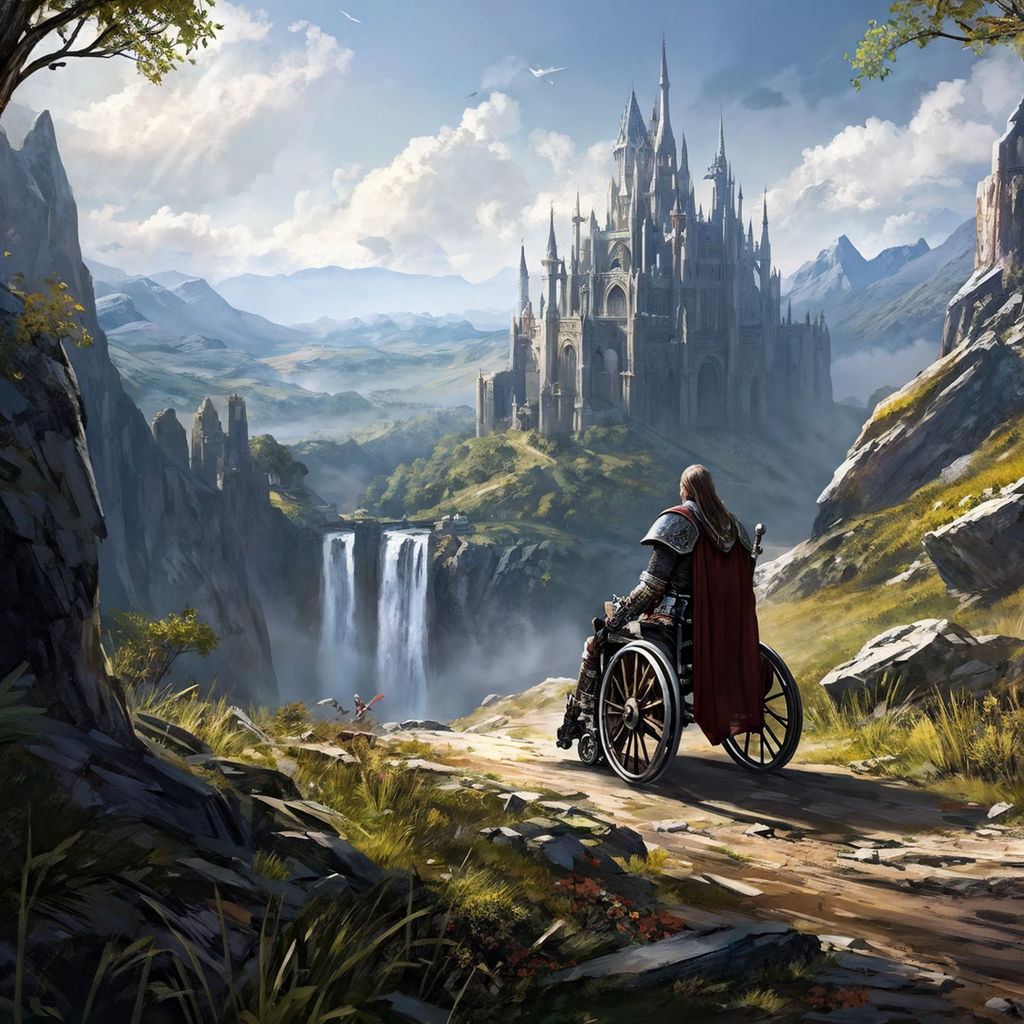
Author’s Note: First, the words that follow are not mine. They’re the work of the co-host of my former live-streams, Rune Knight aka Joe. He can be pretty verbose as many of you may know but he contributed something to the debate over The Great Combat Wheelchair Debate for D&D and I read over it while having tea and thought, why not share his opinion as well?
Give it a read and check out what he has to say.
Now you know you screwed up. While it might be little more than screaming into the uncaring void, I was driven to make a comment not otherwise bound by a character count because I want to talk about the Combat Wheelchair. However, I don’t just want to talk about the Combat Wheelchair: I want to talk about the discourse about the Combat Wheelchair because we have three broad spectrum stances that need to be addressed.
So first, let’s define the Combat Wheelchair. The eponymous magic item was devised by a person who works with special needs individuals and was created so that they, the people they work with, could feel seen and represented at the gaming table. It’s a weird flex. It presumes that somehow the disabled aren’t welcome at gaming tables, or if they are, that they are a silently suffering minority surrounded by Greek Gods who remind them of how second class they are, all the time. I guess their heart is in the right place, though.
The chair mechanics stirred a lot of interest, and a lot of controversy, and even inspired some people to make a version for Vampire the Masquerade, each hand crafted by a pair of Tremere as charity to the differently abled vampire. No comment about how the predatory nature of vampire society encourages exploitation, or how no one should trust a Tremere with any gift they give because of that clan’s long history of betrayal. To say nothing of the fact vampirism is an elective state, and a sire would only choose the differently abled out of twisted obsession, exploiting their useful talents, or ensuring they are wholly incapable of resisting their parent and principal abuser. That’s a different rant.
Thing is, the Combat Wheelchair which has been since taken down spawned all this debate because it was a for free level one magic item that could not be targeted by enemies (though they laughably patched it so it could only be struck by crits), is not subject to mundane misadventure, and it effectively is a free casting of levitation mixed with feather fall and some kind of telepathically controlled perpetual motion. The Chair and the user are ostensibly one, meaning that there is no difference between the two and the user is perfectly as able bodied as the next adventurer, they just don’t get out of the chair.
It’s not even a floating disc or some kind of self-propelled wizard throne. It’s just a modern sports wheelchair which supposedly can fit through every doorway, ascend every ladder, and avoid every pitfall associated with how damn annoying these things can be. The art even varies wildly depending on whether it is wooden or metal and doesn’t differentiate.
But none of that qualifies me to have an opinion, right?
This was made by an expert.
Well, about that…
I’m a 43-year-old disabled person with Cerebral Palsy, a watershed of conditions that largely affects motor skills. Luckily for me, mine is minor enough it doesn’t affect me mentally and I am able to walk for now (let’s see what happens in a decade that’s why I have a multitude of awesome canes). I’ve had a broken leg and I’ve had leg surgery, so I’ve been in wheelchairs multiple times. Later in her life my mother developed Diabetes and had both legs amputated. She in turn had to use both push and powered wheelchairs, and as one of her primary caregivers – I had to get certified and everything – I had to know a lot about the care and maintenance of a wheelchair to keep the thing functioning.
I also, as it turns out, off and on practice various forms of HEMA or did for some years in the past. In addition to going out in the dirt and getting bruises with the boys, I regularly struggle with falling on my face through no fault of my own. I smash everything and sometimes it can take days to recover. Sometimes, I worry I will have to drag my broken backside to the phone to call 911 and wait with my weary brow on the cold floor until they can collect me. As of this writing I have an injured heel, two deep gouges in my left arm that are healing nicely and have fully recovered from bruising my ribs when I did a full body bellyflop on my wooden kitchen floor.
But what does that have to do with the conversation about the Combat Wheelchair? Because, this debate not only has to stop, but it has crossed the event horizon from what we can charitably call stupid to universally offensive. So, let’s consider the positions at play:
Position one is the armchair activist who supports the Combat Wheelchair. They are in line with the creator of the thing, and think they are helping an oppressed minority. It doesn’t matter what reason or logic you bring to the debate, because they’ll simply respond one of two ways, either you shouldn’t worry because it’s just a wizard game or you’re a bigoted, sexist, homophobe, transphobic, Islamophobic, transgressive monster if you won’t allow cripples to play D&D.
None of which is true, of course, and no one is saying that because these are games of collaborative make believe in a fantasy land and who you are at the table does not matter whether you can play or not. They will even point out the rules are optional, but whenever you suggest you might not use them, they will become equally upset and demand you stand on your head because “How dare you ostracize those poor people?”
Well, let’s nip those in the bud right now.
Hi, I’m a cripple. I do, in fact, struggle just to get through my day. I have literal scars to prove it. I was not put here to make you feel better about your life. I am not an inspiration. I do not want your lionization any more than I want your pity and it is offensive to me on a personal level that you fight the good fight in my name when I never asked you to. I do not feel oppressed, or unseen, or I didn’t until you started this little crusade.
These games are escapist fiction. Everyone should be welcome. Everyone can be anything they want to be. If some guy really wants to play a disabled person there should be options to do that in a context that makes sense. If the rest of your table isn’t, well, that’s between them and you and maybe you should find a different table. But it isn’t a war, and I don’t need you firing shots in my name. I’ve never met a disabled person who wanted to be disabled. I’ve never met anyone who was willing to break bottles and chains over someone’s head to make it happen. And mind you, when I was seven years old and my mom was working telemarketing, her boss was a guy with no legs named Jay who used to run disabled marathons on his hands. He was fast as lightning. He still would have liked his legs back, and I don’t surmise he would have played a half a nugget in D&D of his own volition.
You can say people who disagree with you lack imagination, but that goes both ways: you can’t imagine your disabled friends as anything other than crippled and your bigotry is vulgar.
Position two is essentially the wargamer position. It postulates that not only would no disabled person become an adventurer, but that no disabled person can become an adventurer. They would be too much of a burden to an effective party to do the job of adventuring.
This is only half right.
It is true that the wheelchair, especially as presented, is unacceptable in the gaming space. Furthermore, a non-powered wheelchair is a nightmare to manage. They get stuck, they get damaged, they get scuffed, and no amount of magical handwaving can or should alleviate that. Even in the pseudo renaissance many role-playing games are in, the plight of the disabled person is terrible. Before wheelchairs people had to be carried if at all or pushed themselves on some kind of skateboard-like platform.
It is also worth mentioning that disabled people with quick wits could fill any number of clerical or secretarial functions. In ancient societies people with disabilities, if they were not exposed, were considered touched by the divine in some fashion and could fill ritual requirements. And that’s nothing to mention the multitude of bad dudes who fill history books.
I don’t just mean the Viking with bone disease who was an accomplished poet and duelist, or the son of Ragnar Lodbrok, or pirates with eyepatches, hooks, or peg legs popularized by television. Timur Khan was an infamously successful and ruthless battlefield commander. Some research suggests he had a club foot or other misalignments, which were overcome as a horseman in the saddle. There are a pair of German knights, brothers as I recall, who upon losing limbs made metal prostheses with which they could hold swords that then couldn’t be knocked out of their hands, which made them murderous as the most common killing blows are not head or heart, but wrist and ankle. And no one should forget Admiral Nelson who during the Napoleonic Wars was more wooden replacement than man after cannon had taken off both his leg and his arm and he kept fighting until he was finally killed in 1803. The man took his first command in 1781! That’s twenty years of able seamanship getting bits blown off until he finally died three hours after he was shot by a sharpshooter.
Let’s not even get into fiction with Daredevil, Elric of Melnibone, Long John Silver, Professor X, and the multitude of other disabled adventurer characters who clearly meet the bill. The point is a disabled person can be an adventurer, but its extremely rare and it’s not easy. It’s literally choosing hard mode character design, and one should be prepared for all that entails, which could be a very short character life.
That brings us to position three: “Well, just heal it!”
There’re no disabled people in a fantasy world, they say, and if they are you can just cast restoration, or regeneration, or seek a divine intervention. And, while all those things are true, those are options that exist, this is also the most disingenuous and insulting position to have. So, here’s a small side story to explain why:
I have a friend who’s a hematologist. We get along. His husband is a cinnamon roll. And our blood work friend asks me sometimes “Hey Joe, why don’t you just get prosthetics?” or “If you could,” because the technology is getting there, “would you replace your legs?” This is rude because it ignores that the problem is a small amount of brain damage – about the size of a dime – in the motor control portion of my brain from birth. The same birth where I was told I wouldn’t live through the night, then that I would have a lifetime of mental and developmental issues, and now here I am a grumbly grognard collegian.
“Why?”
Because I am used to this. I know my limitations. I know my capabilities. I’ve lived with this for potentially half my life, and it would be incredibly difficult to overcome now. It’s not a snap of the finger and I get up declaring I can walk like Dr. Strangelove. It would be surgery, and physical therapy, and a latter life of adaptation, just to fit in a little bit. It’s a nice idea but I don’t expressly need it.
The “Just heal it” argument is exactly what the activists are bemoaning. That is the elimination of disabled people at the table. It’s not just making the world more fantastic, but it’s pasteurizing it into a flavorless cartoon paste topped with frosting where nothing bad happens to anyone and everyone has perfect health care. Even going back to the old school priests’ services were not free. Healing spells were costly in the form of reagents and components, and the quest for curatives and mythical sites was a massive part of the game expressly because not everyone can have everything all the time. People get wounded. Peasants go without. Horrible misadventures befall the innocent. You can argue these are the result of evil forces in the world because some malevolent Quasit just can’t go a day without stealing candy from babies, but the fact of the matter is disabled people do exist in your fantasy world and some of them are adventurers. They might not be PC’s, and it might not be common, but they exist.
No one is saying, or should be saying, you must have disabled characters at your gaming table. However, when you assert from your position of authority that a disabled person can’t go adventure, or that their struggle is as easily repaired as a hand wave and a spell, you are diminishing them as a person. You’re right, though, maybe your table isn’t for them but not because they’re unfit; maybe its because you’re an asshole.
The summation, looking at these three positions at length, is that even if there is a grain of truth in some of these arguments it has no longer become about the subject. No one cares about the Combat Wheelchair. No one ever should, it’s a dumb idea. What you’re more interested in now is owning the other side, be it the righties, or the lefties, or the story kids, or the BrOSR, or whatever else you want to decry today. And I’ll say the same thing I said before:
I am not your game piece to win your private wars. Leave me alone and stop trying to advocate for or against my right to exist. Back in the day I could swing a sword. I bet I still can. Not as well as someone in their prime, but well enough to make someone nervous. I don’t demand you accept my disability into your game so I can be seen, but I would expect that you would at least grant me respect and personhood at your table. And, just maybe, instead of declaring one way or the other what disabled people need or want you should take a paraphrase from Lewis Black: “There are disabled people among you, and they will take time out of their busy, busy crippled day, to inform you what they want.”
 The Ravens Nest
Leave a comment