Is Your Game Really of The Old School Rennaisance?
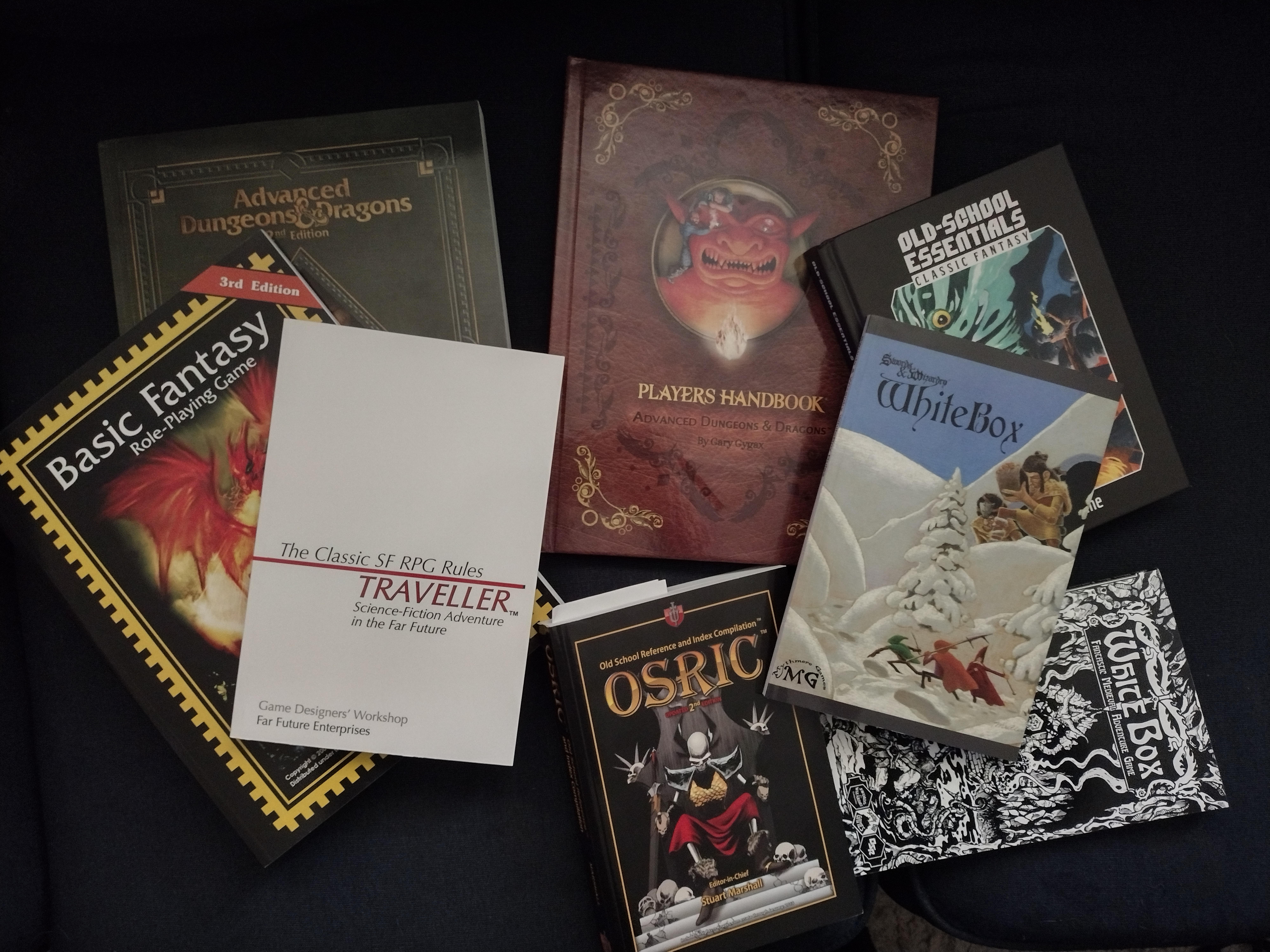
(Pictured in photo: Basic Fantasy RPG, Classic Traveller, OSRIC, White Box: Fantastic Medieval Adventure Game, Swords & Wizardry: White Box Rules, Old School Essentials, Advanced Dungeons & Dragons First & Second Editions)
So I’ve been half-assedly watching this entire thing about OSR vs. FauxSR recently and I’m not sure I understand if it’s just an argument within the OSR circles over Ascending and Descending AC or whether it’s people butt-hurt over Kelsey Dionne’s upcoming Shadowdark release.
What I have noticed is a tinge of something with which I want nothing at all to do and will do everything in my power to stay out of it because it misses the point. As seen in the photograph above (and yes, those are but just a few that I own) this is another bit of pandering, a way to become puritanical, and, of course, alienate large swaths of people within the respective games themselves.
The Basic Expert popped out a video last night on his YouTube channel early and I watched, really not wanting, nor desiring to weigh in on this newest thing myself and I have to say that nothing he stated is wrong in the least. In fact, I’d say he nailed it. Even though he was a little everywhere all at once, there’s not a point that isn’t salient. Watch the video and then read on, carefully and fully, peeps, this one’s gonna get us into the weeds.
Let’s define what the OSR is. The Old School Revival/Rennaisance/Rebirth was a movement by several authors whom moved in to fill a need. Back in the 2000s when the older editions of D&D (and other RPGs) were scarce and hard to come by, you could easily bank on being priced smooth out of playing anything that wasn’t Vampire: The Masquerade or Vampire: The Requiem. What authors such as Stuart Marshall, Matt Finch, Justen Brown and Chris Gonnerman did was take the rules of older rule sets such as (and we’re only using Dungeons & Dragons as an example here) Basic & Expert (B/X), Original Dungeons & Dragons, AD&D First & Second Editions and clone them. They took those rules, reorganized them, cleaned them up and clarified them in many ways and, actually improved them, making playability better and lowering the barriers to entry, if not kicking them down altogether. Many of these games were offered as free PDFs with books being sold at cost or for a negligible profit. To be clear, it wasn’t just D&D getting the makeover, Classic Traveller also got it’s makeover with Cepheus Engine and all of these “retro-clones” began to take form and become widely popular.
Wizards of The Coast, on the other hand, vaulted all previous editions of D&D that wasn’t their third edition.
See, that was the thing about editions. When a new edition came along, traditionally, the new edition was the only one sold on shelves. If you wanted to play a previous editions, it was gonna be harder to find than Deicide fan in a Southern Baptist Church. Sure, you could hit that secondary market but you were gonna pay three, if not four times cover price…if it still had a cover that looked halfway decent. What the OSR did was it took those rule sets and made them inexpensive to pick up, purchase and play. Seeing that there was a market in there, WoTC would later release previous editions in Print on Demand but mostly in PDF.
So now that we know what the OSR truly is, I can now cut to the meat of this article.
Often, growing up, I’d hear such things as “No true metalhead listens to…” or “Everyone who is part of this movement has done X if they were real…” and there it is, eventual puritanism.
I have no doubt that the OSR/Fantasy movement wants to emulate the rule sets put forth by Arneson & Gygax and others, however, there’s nothing wrong with that but now, it’s become a problem with strict adherents chasing down everyone who may disagree with them in the effort to cast them out.
The OSR is nothing more than the resurgence of old-school rule sets and they can be from any genre, whether that’s Fantasy, Post-Apocalypse, Urban Fantasy, Exploitation/Grindhouse, Sci-Fi, Horror, etc. With a seat for every bottom, again, I have severe inability to understand just where this need to label players and GMs comes from. It does nothing to help and only fragments it further.
Let me give some of you who are fighting over it some perspective. There are people out there who should believe that your copy of White Box: Fantastic Medieval Adventure Game shouldn’t exist and you’re every “-ist” and “-phobe” in their book if you purchase it, pick it up and play it, even if it’s a solo game. Those people want control over your enjoyment.
Honestly, the glut of new games coming into the market and new versions (not necessarily editions) of these OSR games that are incoming are a response to the Open Game License Debacle that Wizards of The Coast decided to pull. Yep, it’s a well-known fact that even that company wants control over how, when or even if you’ll play. Are we, meaning those who enjoy these rule sets for whatever reason, really going to do them the favor of dividing ourselves and eventually losing what we have?
If the argument is the old which armor class is better argument, then the answer is simple. Both exist in the OSR. Whether that’s a GM or system preference is completely up to the one running the table. Addition and subtraction, folks, that’s it. It’s not that hard and I suck at math but I can do that.
I’m with Jon over this issue as well. Like he said, I too, love a lot of new games. Games like Night Shift: Veterans of The Supernatural Wars, The Wretched RPG, Castles & Crusades, Cha’alt, Vaesen, Alien, Cyberpunk 2020 & Red, Ten Candles, and the list goes on and on and on, I love those games too. I love the streamlined d20 systems, hell, even some 2d20 systems are still in my libraries, both digital and physical.
Do I consider something like Shadowdark to be OSR? No. What I do consider it is a great game that will bridge the divide if you will between us old grognards and a newer, younger group of players. Did I back it? Damn right I did and I can’t wait for my copy covered in the skin of a basilisk to arrive. Okay, it’s a greenish leatherette cover but dammit, for immersion’s sake, it’s the way I’ll pitch it. Do I consider something like Jason Vey’s upcoming Wasted Lands: The Dreaming Age to be OSR? It does have a rule set that is completely customizeable just like Night Shift: VSW and it does lean into the Sword & Sorcery Fantasy genre for something darker and grittier, so, like Shadowdark, it does possess that old-school sensibility but, again, I consider it a welcome bridge that is being built between the two as it does have old-school rule sets and can be converted to run with the Castles & Crusades SIEGE Engine mechanics. While they’re new games, they still contain that sensibility of the old-school but they are new games. Hell, many of the games listed here are less than twenty years old.
Drop the puritanical posturing, peeps, at this point it’s the most sad devolution of the gaming sphere that we could possibly come up with.
This was a conversation had many months ago when one person (if you’re among my followers who said this, please let me know, credit where it’s due and yours is due) opined that we can have tons and tons of games featuring OD&D rules, however, they’ll become harder and harder to sell. Instead, the focus should be on settings and adventures for these games and I, for one, will not argue. In fact, you, yes You, the one reading this article right this second can write settings and adventures for any of the games listed here today. Troll Lord Games, The Red Room, Chris Gonnerman and so on and so forth are actively looking for people to create interesting and great settings, artwork and the like for their respective games, just to name a few and the barriers to entry have never been lower. It’s high time for us to drop the puritanical preaching and time for us to put our money where our mouths are and goodness knows we’ve been running them to megainflation as of late.
Is the term OSR becoming meaningless? Well, certainly not to me, but if we’re going to keep it meaningful, we have to stop doing the job of the people that want us divided so that we’re easily conquered and pushed out for them. Make those assholes work for it. I mean really make them work for it. Create content instead of creating division.
Is the OSR “anti-woke?” If we take the meaning of “anti” to mean “instead of” then, yes, in that respect, it is. The OSR offers games, not a pulpit. In fact, the OSR can be many things but, at the core, it’s games for the sake of being games. That’s something that I can back and support and will. With that being said, if it is anti anything, what does it push? Well, as stated before, here’s a game, check it out, you might like it. Modify what you don’t like, utilize what you do, whatever you do, make it work for your table and, now that the book is in your hands, it’s yours and the publisher cannot say a single word about it.
On a final note, I agree with Jon on the sentiment that the hobby itself is not D&D. In fact, D&D is just one aspect of the entire hobby as a whole.
Remember, it’s as The Animaniacs used to sing “It’s a great big universe…”
Author’s Note: Be sure to also check out Jon, The Basic Expert’s offerings at Big Geek Emporium and his own website as well as many others. Find the seat that’s perfect for your bottoms.
Author’s Note 2: This content will always be 100% Free to you. There are no plans to monetize it ever. If you really want to contribute, simply comment, subscribe and share these posts with friends. If you feel like I’ve earned that something extra, hit any of the wish lists (There are only two) in the link tree below and you can send a gift. If you send something, please be sure to include your name so I can personally thank you. If you don’t, then simply feel free to enjoy the content with my deepest appreciation for your visit. Thank You.
 The Ravens Nest
Leave a comment