The Destructive Power of Distraction
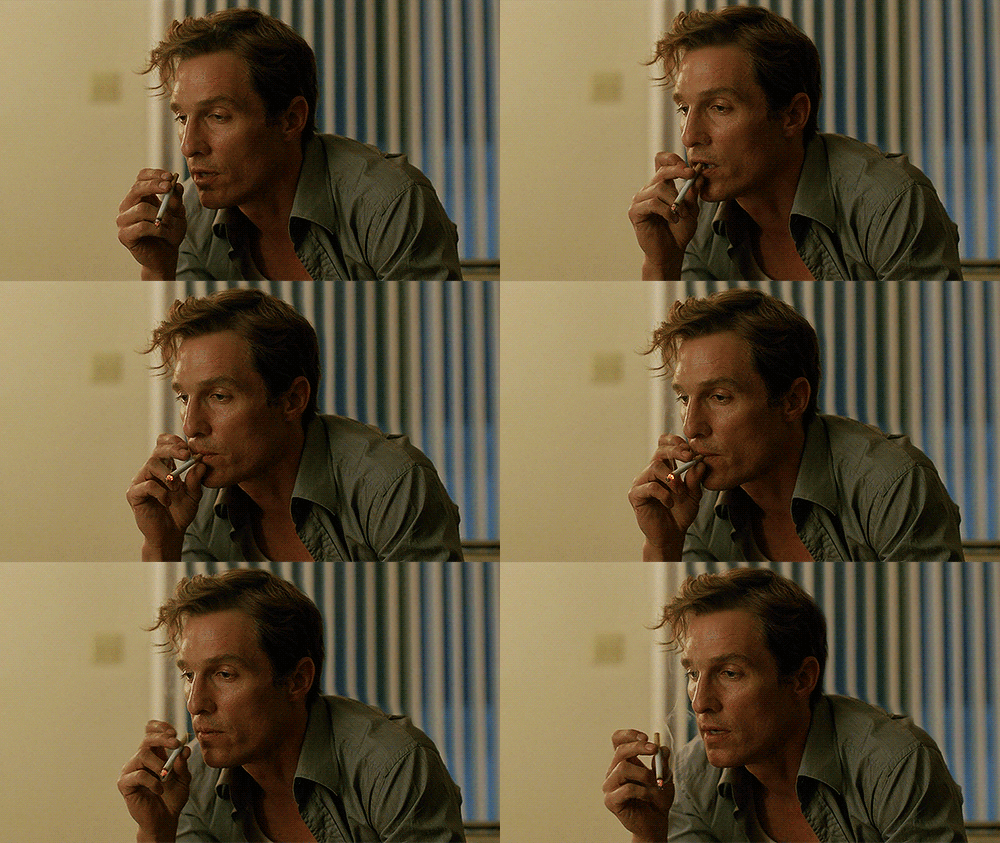
Everyone who’s watched True Detective, Season One, knows Rust Cohle, the self-described “pessimist” who says life is pointless, humans are unnatural to the planet, can’t survive on their own, and should just “walk hand-in-hand into our own extinction.”
There’s a reason he’s like that. The show gives some background, but I don’t want to spend a ton of time analyzing a character you can easily go watch.
What I want to talk about is the time I not only identified with Rust, but completely agreed with him.
Here’s what many of you don’t know: the first season’s themes, evidence, and case itself stem from something that happened in Louisiana. I’ll tell you what the show did to diverge from the actual events, what it got right, and why I found myself agreeing with Rust Cohle.
Fiction vs. Reality
The murder in Erath, Louisiana, wasn’t real. What the show did was mix something real with something out of Lovecraft, Bierce, and Chambers. They framed a cult inside an abandoned church centered around Carcosa and “The Yellow King.”
If you’re not familiar with the series and don’t want spoilers, go watch it and then come back.
Rust experiences things most of us don’t. On top of trauma from losing his wife and child, plus what he did while undercover for two years, he probably had synesthesia, where synapses misfire, causing other sensations when they weren’t directly stimulated. He comments on this: “I don’t like this area. Leaves a bad taste in my mouth…like ashes.” Throughout the series, this explains his “hallucinations.” That matters because it explains why Rust treats what he sees as evidence, not truth. He focuses on facts, not hallucination.
Even after he quits the Louisiana State Police, Rust continues to investigate on his own. The case ends with children victimized, meth running rampant, and both Rust and Marty nearly killed. There’s nothing supernatural involved. Carcosa? Never happened. The Yellow King? Purely literary.
The Reality: Hosanna Church
Erath is in Vermilion Parish. The Hosanna Church we’re talking about is in Tangipahoa Parish, specifically Ponchatoula. Many of the locations in the show are close to my old stomping grounds near Lake Charles, which made it familiar enough to me to really buy in.
The events surrounding Hosanna Church are seemingly worse than the TV show depicted. I’m going with worse because they’re real. Very real. Please read carefully.
Back in 2005, the pastor, Louis Lamonica, voluntarily went to the Livingston Parish Sheriff’s Office and confessed. He was arrested. So was his wife.
Deputy Christopher Blair Labat was also arrested for his involvement. The arrests caused a media frenzy.
The media went apeshit with stories of pentagrams, loose floorboards with corpses of children and sacrificed animals, and so on, turning it into a sensational “occult” story. Richard Ofshe, known for work on false confessions and the West Memphis Three case, testified that this wasn’t a satanic cult but a cult based in Christian beliefs.
Fact: Mental gymnastics isn’t an Olympic event, and I wish people like Ofshe would stop publicly training like they’re going to place. This is more of the same distraction because he spends his time on the stand pointing at something this isn’t. It’s almost as if Ofshe was trying to soften the fact that these people were predators and nothing less.
Here’s the key: police had to repeatedly stress that this was a case of child abuse. Nothing more.
The crimes go back to 1999. Six years.
Guess who worked in the Louisiana DOC from 2001–2009? Yep. Me. Never saw any of these people come through my prison, probably holed up somewhere else, and that was good enough for me.
Confirmed Convictions
Here’s what is confirmed:
Louis Lamonica: Convicted of aggravated rape of minors; four concurrent life sentences, upheld on appeal.
Austin “Trey” Bernard III: Convicted of the same; three consecutive life sentences.
Paul Fontenot: Convicted of sexual battery of a minor; 10 years.
The rest, including the deputy and Lamonica’s wife, were charged, but there’s little public record of convictions. Some pled down; others were likely acquitted.
Police reported that up to 24 children may have been victimized, but in court, only three were specifically named and confirmed — two boys and one girl. Still three too many.
The Revelation
I learned about this earlier this year. After moving 1,300 miles from home, I realized something: while all the 3 a.m. calls of “We’re gonna kill all you freaks” were happening, while I was treated as the threat, this event was going on, and I wasn’t a threat to anything or anyone except a body opponent bag at my gym and whatever baddies video games sent after me.
The rage I felt could have been destructive, but it never became action. That anger turned inward. Around that time, the Halestorm song Darkness Always Wins reminded me: depression is anger turned inward.
Splinter from Teenage Mutant Ninja Turtles said it best:
“Anger clouds the mind. Turned inward, it is an unconquerable enemy. You are unique among your brothers, for you choose to face this enemy alone. Do not forget them, and do not forget me.”
That’s exactly what it felt like — confronting reality, knowing your family is far away, feeling unconquerable.
A World of Monsters
People ask me why I write horror.
It’s not because I think the world is grim-dark. It’s because horror is honest about where monsters actually come from. They don’t come from symbols, rituals, or myths — they come from people who know exactly what they’re doing while everyone else argues about the wrong thing.
Distraction doesn’t create monsters. It creates cover.
And once you understand that, you stop waiting for the world to make sense. You document it. You survive it. You warn others if they’re willing to listen.
That’s not pessimism. That’s adaptation.
So really, what does Rust Cohle have to do with the Nocturneverse?
Meet Ronnie “Red” Dalton: a mix of Rust Cohle’s pessimism, Robert “Marlboro” Lee’s swagger, and John Constantine’s bad habits. He’s faced horrors and has enough insider knowledge to survive and sometimes, to use force when necessary.
I’ve met people like Dalton. They’re all swagger, bravado and able to back it all up when the chips fall. Once these types exhaust that, though, all they have left is just what I do; keep going.
Some of us are just too stupid to tap out when told and too aware to look away.

 The Ravens Nest
Leave a comment