Why Separation of Fantasy And Reality Is Important More Now Than Ever
This is a subject that absolutely chafes at times. I am sitting at my desk and up above me, on the shelves of my desk hutch are a nice library of books. I’ve got Shadowdark, Lamentations of The Flame Princess, Old-School Essentials, Savage Worlds, Wasted Lands: The Dreaming Age, Night Shift: Veterans of The Supernatural Wars, Mothership, Cyberrats, Cowpunchers, Atomic Punk 2160, White Star, Macuahuitl and a few others. Most of them are Zines and Zine-Style game which, to the uninitiated, means they’re small booklets that contain an entire game.
In my library, there are plenty of other games as well. One thing I can tell you is that the genres range from Old West and Medieval Fantasy, all the way to dark future cyberpunk and cyber-fantasy games.
Growing up, I had always heard that games like these could get me into destructive occult practices.
Let’s start with something, shall we? First, the definition of the word “Occult” means “hidden” and you should know that, where I work, the company Bicycle offers playing cards with strange and esoteric symbols and the theme of it is literally entitled “Hidden.” Magazines on the racks these days bear titles like Inside Secret Societies, A History of The Occult, and Witches: Fact And Fiction. Growing up, I’d see magazines on the racks bearing Baphomet and other symbols and dark figures in obviously staged photos with sensationalized titles and articles.
Let me tell you, that would capture your imagination as a kid. Back home, I’d pull out He-Man and my Masters of The Universe figures. Skeletor would begin to build a cult dedicated to him. He’d use his foul powers to use magic to start to influence the outlying realms of Eternia. Eventually, He-Man would find that Duncan and Teela would go missing. Something was creeping into the kingdom that he was set to inherit. Turns out, Duncan fell under the spell of Skeletor and was used to construct a device that would sacrifice an unwilling Teela and bring about more power to Skeletor. He-Man would have to battle his way through the cult and save both of them somehow. Needless to say, Skeletor’s plans were thwarted, the machine was destroyed, Teela and Duncan both were freed and the cult fell out from under the spell, everyone returning home and Skeletor left defeated and believed dead.
Yeah, you start putting headlines out like that and I’ll start using them. For me, those dark forces were something to fight, not join. Even today, that’s still something I believe in entirely.
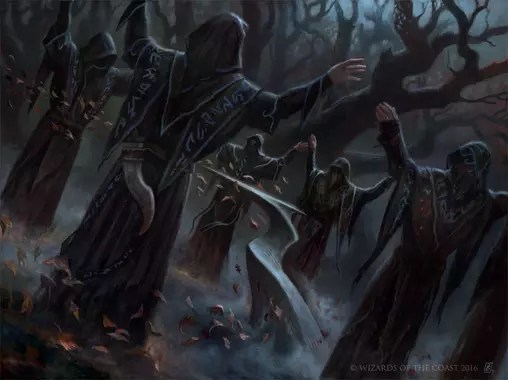
AD&D 2nd Edition stripped out the devils, demons and assorted stuff. They got re-added later in supplements but, by the time I got to it and the material I had, none of that was present. Even in the 3.5 edition games I had played, sure the occasional cult would pop up but they weren’t exactly world-breaking. They were small and usually attempting to summon something nasty. Sometimes the cult would succeed only to be eaten by the thing they summoned, sometimes, not so much but they never truly played a prominent role.
Cults factored into movies like Conan The Barbarian and even The 13th Warrior if we’re talking adventure movies. If you like your cults more flavored into games like Call of Cthulhu, then I recommend the movie The Void.
Call of Cthulhu and other games related to that game can’t shy away from it’s esoteric elements. In fact, in this game, they were necessary because, your investigator is attempting to stop someone or a cult of someones from summoning a cosmic horror ripped straight from the stories of Howard Phillips Lovecraft. If you’ve ever read his works, you’d know that this never ends well for his characters, ending up dead or insane from the things they’ve witnessed.
In tabletop RPGs, even a treasure cache can be considered occult due to some pirate burying it, leaving a cryptogram that only he understood in order for him to retrieve it later. Words mean things, people. Occulted (hidden) things are not the esoteric practices that we’re seeing more of in the real-world today. In fact, the esoteric was more occulted when I was a child than now.
Today’s gaming doesn’t shy away from it at all. The Devils, Demons, Lovecraftian horror, cults are now displayed in the books prominently. The esoteric and occulted history within the game are presented as clues to aid in investigations to track down these evil schemes, stop the cults, save the people who have no idea what’s going on and fight the horrors themselves.
That’s the way it always was and has been.
White Wolf Games turned that on it’s head by allowing players to play as the vampires, werewolves, wraiths, changelings, mages and hunters. Still, the esoteric set a theme and tone, were translated into dice mechanics and of course, all in service to gameplay and nothing more.
Lamentations of The Flame Princess (Go buy books now while you can) uses the trappings of The Devil and The Satanic as provocation and edge more than anything. The thing to remember is that this is a horror game that postures as a fantasy game and it’s for mature audiences.
What do all these games share in common? While some of their esoteric elements, themes and tone could have been ripped from the real thing in some ways, it was all in service to the fictional, not the other way around.
For myself, personally, my own practices in tarot, oracular work, runes, manifestations, etc are mutually exclusive from my gaming. While gaming can keep folklore alive and preserved, it’s important to note that separating fantasy from reality is absolutely something that my own parents did and parents should continue to do in order for people to engage in the hobby in a healthy way.
Where the two intersect for me is these books, particularly.
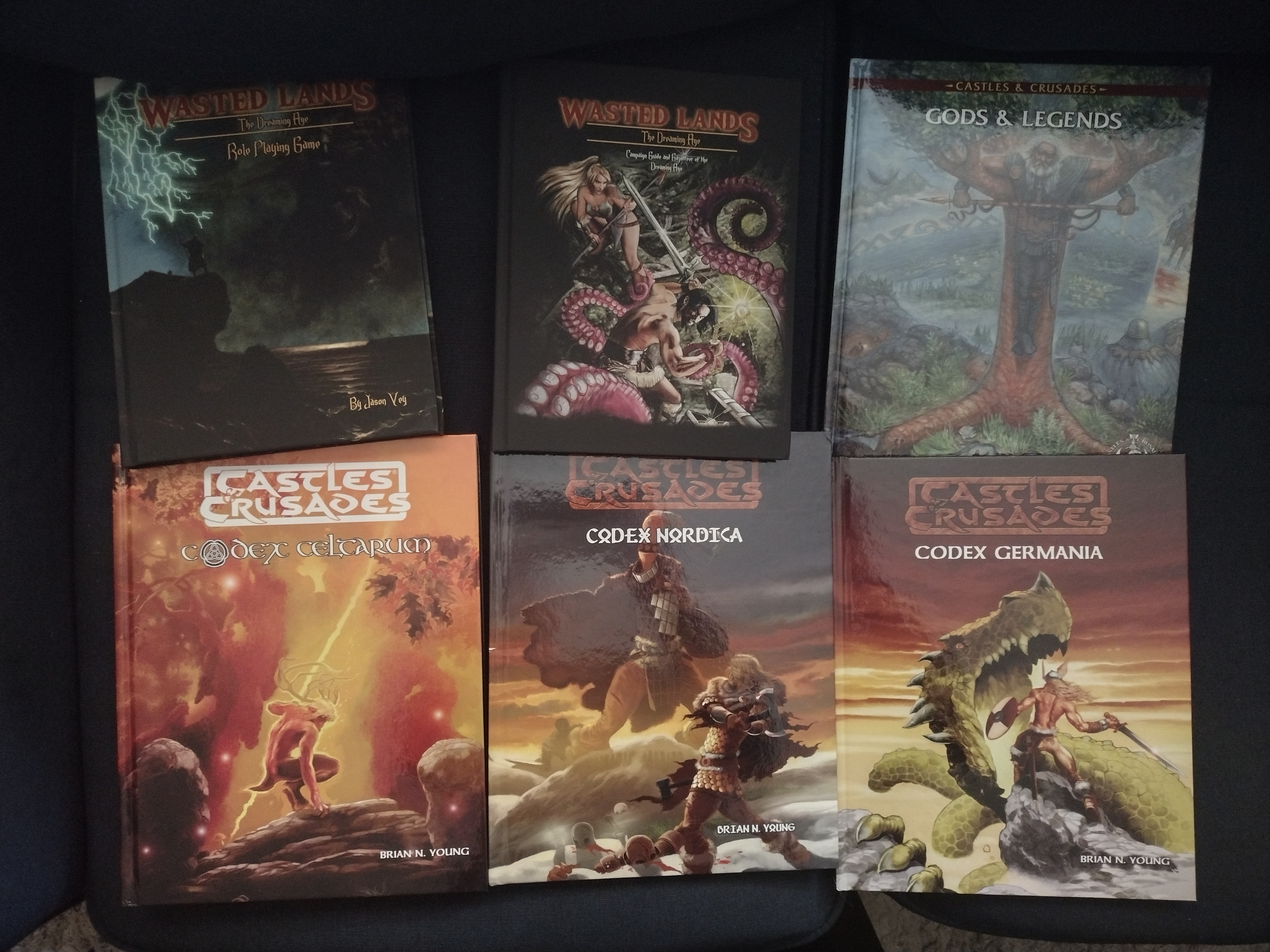
The thing to keep in mind is that while these books for Castles & Crusades are well-researched and contain a lot of the cultural heritage for me, they won’t be anything more than gaming sourcebooks. I’m not pulling these books out if I need to know something about a deity unless it’s for the game or I need to accurately present one of the deities to the player. I also have supplements that bring in Greek, Slavic, Egyptian and Ancient Chinese gods and legends and yes, they’re compatible with Wasted Lands as you can play a character who eventually, via legends, becomes one of these mythological deities. My only gripe is, Jason…dude…no Bulfinch’s Mythology as recommended reading? Bruh…
In any case, if I need to do study into my spiritual life, I have books that are in no way related to gaming. I know people from many different walks who love taking on devils, demons, titans, jotnar and the forces of entropy and besting them or staving them off for another millennia or two and they’re not being asked to give up that which they feel right in their souls and bones. In fact, James Raggi IV has gone on record by stating he’s an atheist but it’s not as though he’s trying to convince you that your spirituality is false or mine is, respectively. He uses those trappings because his game delves into the really weird sides of things and some of what is presented is so over-the-top that taking it seriously would not be something a sensible person should do. All I’m saying is that The Book of Antitheses should be taken with a grain of salt. The book opens by telling you that, by virtue of opening that book that your soul is now condemned to eternal torment forever. Take it for what it is, something tongue-in-cheek and move on.
The problem that presents itself is when people aren’t honest. With the popularization and constant catering to mental disorders these days, reason can seemingly go out the window on both sides of the fence. It irks me to see an RPG sell tarot decks because, if you’re encouraging the players and game masters to start playing with forces they don’t fully grasp with only the game as their guide, combined with the mental disorders that have become popularized especially as of late, you’re inviting in a lot of trouble and proving parental groups of old such as Patricia Pulling’s Bothered About Dungeons & Dragons (B.A.D.D.) to have more credence to the messages that were being sent as scaremongering tactics. Some of us went through pretty horrible times over those fear-based messages having no basis in fact. Now companies are giving them basis in fact. I still use The Necronomicon as a tool for my Call of Cthulhu game prep because I know that it’s merely fictional. It’s used to create clues that will ultimately lead investigators to the cult in attempts to stop them or to face off against the horrors themselves when they come up from the sea or through a dimensional portal but it’s never preached as something that the player should take as fact.
Parents should decide what is appropriate for their kids to consume in terms of media whether it’s books, music, movies or TV but all of the decisions should be based on rational, deductive reasoning and fact first. If you as a parent are unable to separate fantasy from objective reality, you can hardly expect your child to do the same.
Still, you can always rely on one thing; you will never see me use a Dungeons & Dragons Tarot Deck in my readings, ever.
 The Ravens Nest
Leave a comment