Why Projection of False Responsibilities On The GM Can Take A Bad Turn
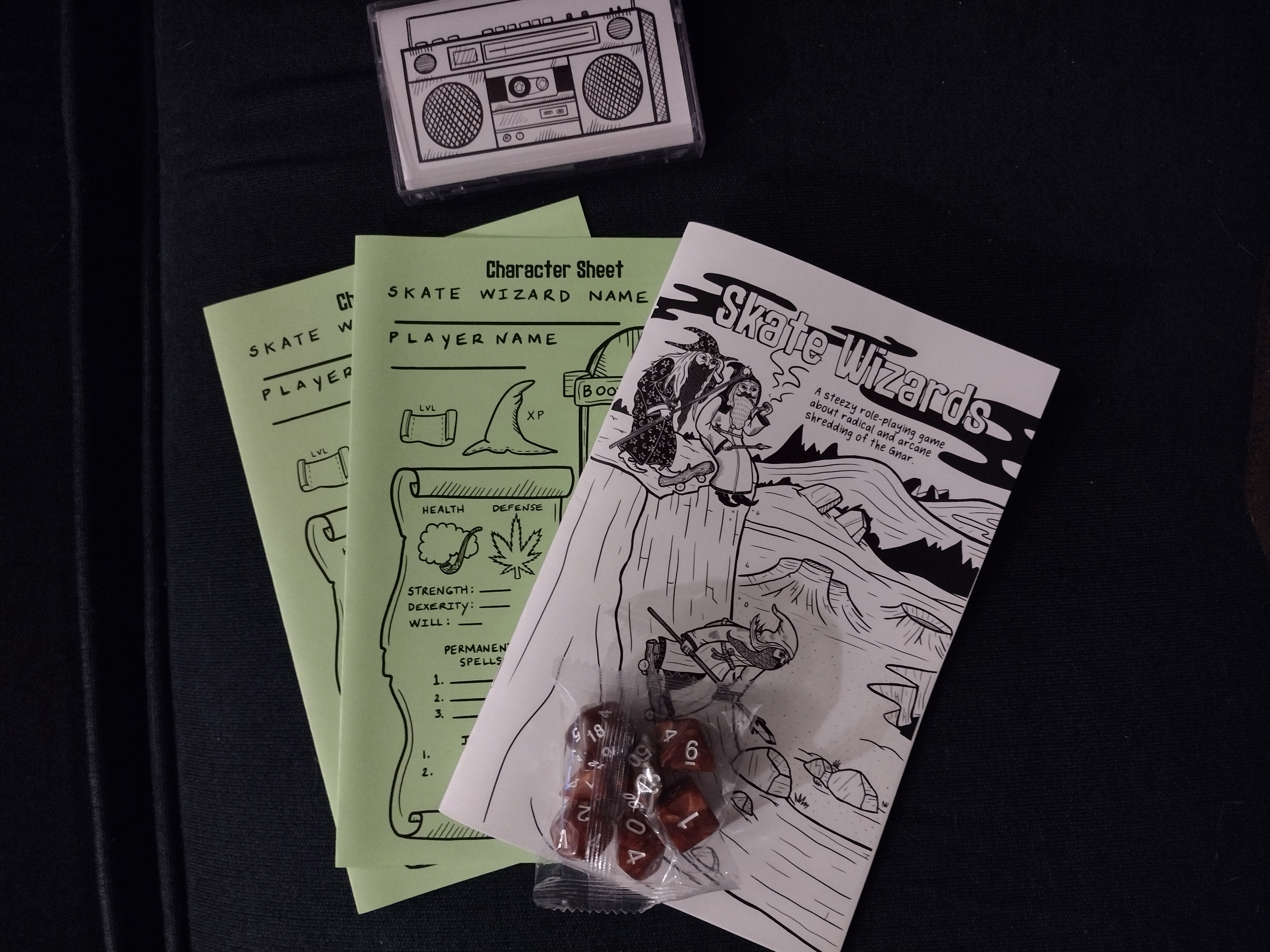
Author’s Note: Before I kick this article off, I wanted you all to know that this game and it’s soundtrack are back in stock. It’s a fun game called Skate Wizards and you can get everything seen here, including PDF of the game and Download of the soundtrack all included for about $35 shipped. It’s an absolute great time and you won’t regret playing it and having a lot of laughs, go check it out!
*************************************************************************************************************
I don’t like giving the following person any type of attention but this time, he’s really stepped into the deep waters.
To nutshell Garibay’s stance, now the GM in any game must act in the role of a therapist as, that’s why the player is there.
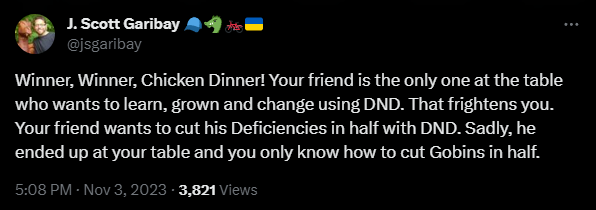
What Garibay doesn’t seem to understand is that his entire premise is a false one. Garibay lives in a neighboring state to me and doesn’t seem to understand policy. Policies that, no doubt, he’s probably supported and voted for on numerous occasions.
Games like D&D, Cha’alt, Old-School Essentials, Hostile, Alien, Tales From The Loop, Cepheus, Traveller, Cyberrats, Night Shift: Veterans of The Supernatural Wars, Wasted Lands: The Dreaming Age, Labyrinth, The Dark Crystal, The Wretchedverse, Dark Places & Demogorgons, etc. can be therapeutic in the way that they take you out of your mundane day-to-day and transport your mind into other worlds where you can be someone that you’re not, have adventures, create great stories collaboratively or on your own via solo play and, for some, the game alone is what helps them keep their sanity. If employed correctly, the escapism factor is a big help for someone finding themselves constantly bombarded by the stresses of daily life, it gives the player and GM both something to look forward to. To meet with good friends and have great stories around a table is a time-honored way of preserving cultures, reviving others and giving everyone involved that moment of light in an increasingly dark world.
Still, these are not therapy for more underlying, and deeply-seated problems within someone’s psyche.
Decades ago, Roma Jaffe wrote a book called Mazes & Monsters that detailed a college student with mental and emotional issues, playing in a game only for the game to slowly creep in and dominate reality. It exacerbated the problem that he already had. He’d grown so attached to his character that it made up the core of his personal identity and caused even more issues. It was loosely based on the case of James Dallas Egbert III who committed suicide after it was found that his involvement with his college’s Dungeons & Dragons group had little to nothing to do with his suicide and more that there were other problems at hand that hadn’t been dealt with properly. Later on, a movie by the same name would be made and released, starring a young Tom Hanks.
The movie, to most of us a mere ten years ago would be seen as a bit of anachronism, an archaic look at how the media seized on an unrelated aspect of a story and sensationalized it to no end…or to even a tragic end. In fact, for some of us, the results of that sensationalism were pretty profound and something I’ve covered in previous articles.
Today, people like Garibay seem to believe that you, as a GM have some supreme responsibility to be the world-builder, therapist, caregiver, mental-health professional, parental figure and unquestioning saint to your players and, should one player have more issues than anyone at the table, it is now your responsibility to wear all those hats simultaneously, stop being so selfish, warp and twist your entire game around that one person at the expense of all others.
I remember having conversations with my parents over the controversy surrounding media properties like The Simpsons, Beavis & Butt-Head, Mortal Kombat and many other forms of media and art that were being consumed by the younger generation. We would see stories about these kids in remote places in the country doing something incredibly stupid, blaming the media property and then a crusade would be launched and my dad always had the same question, “Where Were The Parents?”
That’s really where it starts. Parenting. I’ve often stated that parents should be well-aware of the media their children are consuming, how much and discuss with them what’s real and what’s not. I can’t count on both hands and feet how many times my own dad was quick to point out when watching episodes of G.I. Joe and The A-Team that, when a person is shot, they do not get back up. He was always checking in on whatever I was reading, listening to or watching to see how well I was able to separate fantasy from reality.
What does a parent do when that doesn’t work? Hey, sometimes even the best of parents can fall short. That happens and that’s something I understand.
Seek therapy for your child from a licensed professional.
Reader, I know it took a long time to get here but this is where we get to the point and I’m thankful you stayed for this because it’s important information we all need and I have to make some restatements on the Twitter thread that I did yesterday concerning this very point.
Licensed therapists have been trained and have been equipped to handle these very things. I know some have misgivings about the therapists and their connection to Big Pharma but that is not the point today. I understand those and that’s another subject for another time. Right now, I’m pointing out where Garibay’s rhetoric is not only stupid but dangerous.
While there’s no harm in being kind in sitting down with a player between sessions and expressing your concerns about their mental state with them in an honest and meaningful way, the facts are still facts, you are not their therapist. You’re not licensed, trained, equipped or experienced and I’m only talking to the GMs who do not hold licenses to practice. If you do have a license to practice and the training and the equipment, this article does not apply to you at all but your comments are still welcome.
So, for the rest, what does that mean for you? The answer is simple. I want you to think about your game. I want you to think about how much time, effort, strategy and work you put into that game in preparation. I want you to think about how you schedule, how you meet with your group and how good those times are.
What if, one day, you suddenly can’t afford gas to get to the venue, can’t afford so much as a bag of oreos for your group or even a case of water? What if, one day, you can barely afford a notepad for taking notes and you don’t have players that are willing or able to take care of those needs for you? Worse, what if you can’t make it to any more sessions for a good, long time?
Think on that for a moment and come back. Don’t think I’m just talking out of my ass here. I’m not because, depending on your state and local laws, you could find yourself both financially and criminally on the hook for practicing as a therapist without a license especially if something goes wrong with that player at your table. You could find yourself saddled with tens of thousands of dollars in fines, jail time, prison time (yes, there’s a difference) or all of the above.
On a related note, I’m licensed to be a pharmacy technician. According to my state, I can walk into the pharmacy where I work and dispense medications, including controlled substances, sell them and even interact with both doctors, nurses and insurance agents in matters of adjudication. If that license expires, I will not be able to do that until I renew it or go through the application process again, depending on how long it has since expired.
There are limits to what I can do and I just listed every single one of them. I am not allowed, by law, to recommend even over-the-counter medications for so much as a sniffle. Only the pharmacist on duty can do that.
I am no longer a practicing Pharmacy Technician, I now work in the photo lab which is something I like a little more for different reasons. Even after a year of being out of the pharmacy, I still get questions like “What do you recommend?” to which I have to, by law, respond that I can’t make recommendations, only the pharmacist can.
At present, I also hold a doctorate in Divinity which allows me to put the letters PhD after my name or even the title of Rev. Dr. in front of it. It doesn’t mean I can pull out a prescription pad and write you a script. At best, the only counselling I can provide is spiritual and that is all I could offer.
I can’t tell you how many time’s I’ve gotten the lowdown and funky on someone’s hemorrhoids only for the person asking me for recommendations suddenly worrying about being judged by a pharmacist. Seriously. I honestly wish that were a joke.
Digression aside, if my state will not allow me to recommend an OTC sleep medication containing diphenhydramine would be the exact same as the generic Benadryl (with the same exact active ingredient) as an antihistamine, then I seriously doubt I’d be in less legal and financial trouble if I were to suddenly step into the role of a psychiatrist at the gaming table. It doesn’t matter how someone tries to white knight and frame it, those are facts and facts that will inevitably come back to haunt the GM who decides to step into that role. Even in this article alone, we’re discussing matters of law and I can’t even advise you of what you should legally do. My only advice is to seek the advice of an attorney. Most attorneys will provide a free counselling session and will answer questions free of charge. From there, you can make your own decisions.
The best advice I can offer is this.
Vet Your Tables. If you decide that your table is by invitation-only and you game only with people you know, this is the route I endorse most because then you at least know who is at your table and what the personality quirks may be.
Before character creation even becomes a thing, have a meeting where you discuss the rules for your table, what the setting expectations are, what rules are hard, fast and non-negotiable (and stick to them yourself) and which ones are more flexible and open to discussion.
Let your players know that Player Character death is a real possibility and why. This is true of any and all RPGs. Give them the heads-up that it would be best if they had a second and third character rolled up just in case. I recently lost a character a couple of sessions ago in my playtest of Horde Wars and it took me less than 20 minutes to compose a new character for the last session I played. The dead character also died in my Basic Fantasy RPG one-shot I did with a friend toward the end of the adventure but he’s alive and doing well in a couple of other games.
Let your players know that, should they have any dealbreakers in getting this information, now’s the time to bow out, respectfully. This is also a good time to let your players in on what optional rules, if any, will and will not be used. Use this time to manage expectations.
People, this is the extent of your responsibility as a Game Master, Referee, Judge, Dungeon Master, whatever title is applicable to your game. That’s it. Keep It Super Simple and you will avoid many more potential problems in the future.
Some games, movies, music, books, etc. are just not for everyone and there’s nothing wrong with that. With the absolute mass of games out there, there’s a seat for every bottom, a table for every player and game master and even something for the solo player who can’t make it to a game or can’t seem to get a table together whether virtual or otherwise and it should be understood that this is always going to be the case.
Let’s also consider something here, Garibay’s lack of credibility. There was this gem he posted once, have a look.
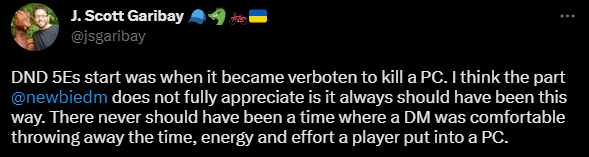
I have asked Garibay numerous times for proof of his claim and he has yet to answer and this was what I had to offer in return…
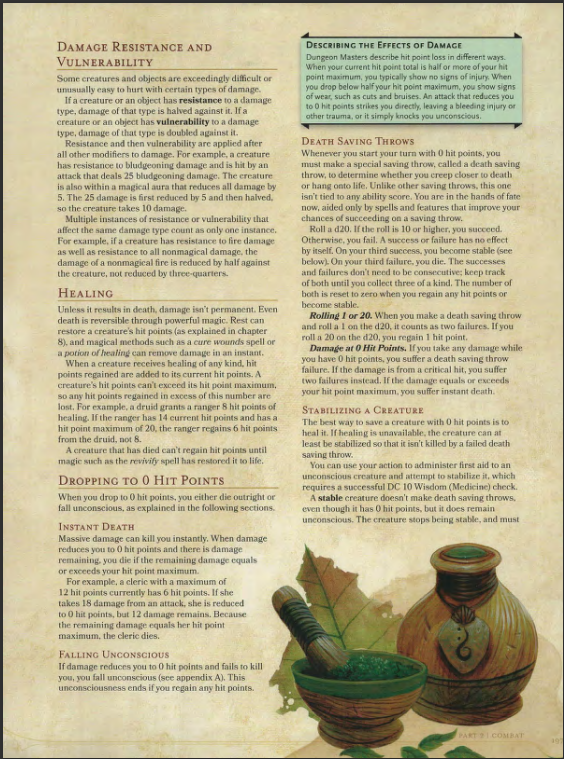
He may have the Dungeons & Dragons Player’s Handbook and I can’t speculate on whether or not he has it or he doesn’t, I’m just going to concede that perhaps he does, however, other possibilities exist that he has either not bothered reading it or is flagrantly ignoring both this page which is specific or even the free, downloadable PDF of the D&D Basic Rules which anyone can get.
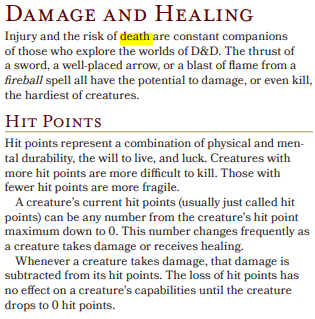
While many rules do make it more difficult to kill what is essentially your medieval superhero (Anyone who reads the PHB and DMG will see this is the case) it isn’t impossible and, plenty of characters in 5th Edition Dungeons & Dragons have died in heroic and even noble ways, impacting the game without their deaths being meaningless. Even the YouTube Channel CritCrab has found and shared some of them.
If Garibay can’t even bring himself to be familiar enough with the rules of the game to tell you that, honestly, character death is forbidden at his table only, then I don’t think I’d listen to him where matters of both civil and criminal law are concerned.
As my dad once pointed out to me, those who can’t separate fantasy from reality should not be playing these types of games. Take the Rod Ferrell cult in Florida, for example. Rather than seeking help for her son, Rod’s mother reinforced his delusions and now, Heather Wendorf’s parents are dead because of it. Ferrell will remain in prison for the rest of his life and some of his friends who were involved have spent the better part of their lives in prison. As Garibay chooses to ignore questions from me about such matters, and some have pointed out that he is to be ignored, I can only agree to a point.
When it comes to his takes on the game itself, maybe. When it comes to matters that can irreparably damage lives in the process, the answer to that is a hard no. That cannot go ignored and must absolutely be called out before someone takes that advice and lives are altered in ways that they cannot be undone.
For GMs or potential GMs reading this, I advocate for gatekeeping in this post but only the type that you can do. Vet the books you buy, vet the players at your table, set those expectations and reject all notions that delusions are to be nurtured and coddled out of hand. Be honest, respectful and use some discretion in your descriptions like we’ve done in the last 50 years of this type of gaming being in existence.
For those of you suffering from mental afflictions such as PTSD, Depression, Anxiety, etc, don’t think for a second that I mean you should be locked out of these games. In fact, I’m urging you with all sincerity to get help with your affliction and ask your psychiatrist or psychologist if these games are right for you. Be sure to share the progress reports with your therapist as the days, weeks and months go by and let them know, honestly, where the positive and negative effects are. Remember that type of therapy is between you and your doctor, not you and your GM. Same as I’d recommend that someone ask the pharmacist for a recommendation for some OTC meds for the sniffles, I’m recommending you ask your therapist on their recommendations on gaming.
Finally, to the licensed therapists, I understand, from a personal perspective how therapeutic this type of gaming can be. Whether I was living out power fantasies or having to solve riddles or situations under pressure in any given session, there are just amazing benefits in accomplishing those imaginary tasks and losing sucks, especially losing a character you worked on for many sessions but it is not be all, end all. Strictly from a gamer perspective, I think it’s a good idea to research these games and talk to people who’ve been in gaming for many years in order to find the one or ones that might actually benefit your practice. If you choose not to include them, that’s also something I understand.
Game Safely, Have Fun. Play what you love. Love what you play. Your Table. Your Rules, Always In All Ways.
That’s it from me, folks. Careful who you listen to out there.
 The Ravens Nest
Leave a comment