OD&D can fine-tune and sharpen your DM Skills. Raven shows you how.
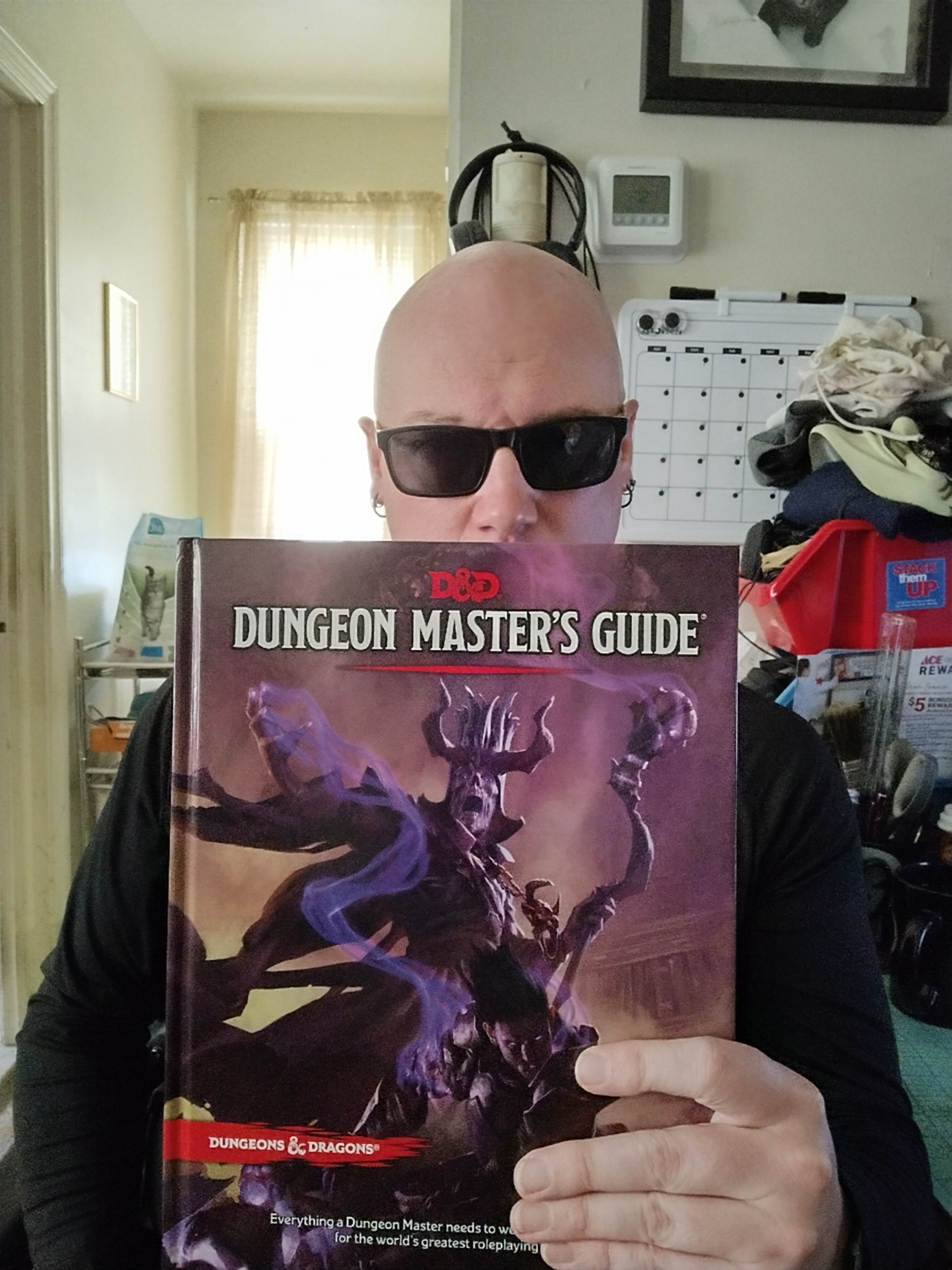
Pictured: Me with D&D DM’s Guide for 5th Edition
When it comes to fantasy adventure gaming, there’s no bigger game in the market than D&D. It holds the highest name recognition, has been in the public sphere with it’s many controversies and has been as American as apple pie and baseball even if it is played nearly worldwide.
Before I go on, let me really pause for a moment here and say that this post will be directed primarily at Dungeon Masters & Game Masters. If you’re a player of the games and you still want to read, then go right ahead because if you’re ever potentially going to run your own game, this is food for thought and prepare for a feast.
The recent controversies, though…yeah. It wasn’t just the OGL scandal, it was also the fact that New York is experiencing a Dungeon Master shortage and, let’s face a fact, the book I’m holding in the above mentioned photo…it’s a mess. It’s all over the place without organization and rules that, by and large, put far too much of a burden on the DM as a world-builder while placing demands of players on top of that.
What if I were to tell you that this wasn’t always so? DM burnout wasn’t really a thing and, when it was, sometimes, a player would step into the role and try their hand at it, giving the DM a break for at least a one-shot game? Well, it’s true.
Original D&D in it’s white box containing three little brown books, a set of dice, a crayon and character sheets was released nearly half a century ago and there are people still in love with that set. In fact, it was something understood in groups that played the game in those basements and at kitchen tables in those days. The days of Original D&D (OD&D or 0E as some like to call it) were more about gritty sword and sorcery than superhero fantasy. In those days, players went in with the expectation of being Merlin from Excalibur, Conan The Barbarian from the movies, or dozens of other literary and movie character analogues.
These days, the push seems to be toward the Marvel Cinematic Universe’s superhero where they are nigh-unkillable and are overpowered at levels that cause the Dungeon Master consternation at attempts to really create challenges and stakes for the player’s characters.
In the days of OD&D, the Dungeon Master was another term for referee or judge and the entire job of the DM was to adjudicate rules, put random encounters in the way of players and see how they dealt with it. OD&D’s rules weren’t clear much of the time, in fact, they weren’t even well-written by today’s standards, however the lack of clarity and rules that didn’t cover out-of-the-box thinking on the part of players meant that the Dungeon Master had one of three options, make notes to put into a letter to be mailed to Gygax, Arneson and crew and wait on a response, make a long-distance phone call directly to Gygax and Arneson to discuss it and take notes for next session or get creative and adjudicate on the fly, establishing what rules were hard-and-fast at the table, which ones were more flexible and which ones just plain didn’t work out. Getting creative was the only choice for some, writing letters bumped up the cost bracket a little bit but could add up as sessions went on and long-distance phone calls, well, that could get very costly, very quickly.
I really wanted to focus on the wisdom of OD&D with this article and show you why it was so wise in it’s design and why OSR games really can’t do without it. See, OD&D was, in itself a bit of a spinoff of Chainmail, a miniature wargame where each player commanded a host of medieval warriors in wars over domain but OD&D, decided to do something different; each player was his or her own character in a medieval sword and sorcery game. The wisdom in it was that, collectively, all the books housed a total of just shy of 150 pages. In that 150 pages were monsters and treasure, character types and abilities, combat and all the mechanics that you’ve come to know and love today to a lesser degree.
The rules-lite nature of OD&D was such that it did leave a lot of the adjudication up to the DM but that wasn’t a burden. The DM simply called it on the fly for the time being, made a note, researched into the 3 LBBs and then came back for the next session with some discussion at the table about the rule, the ruling and whether or not it worked for the table. It wasn’t up to the DM to construct a world, the entire world was rolled at random, the player characters dealt with the encounters and the setting as it was fleshed out the best way they could with the characters having to balance whether or not that combat was worth possibly dying and having to roll a new one at the table or have a backup.
In any case, starting in a tavern as just being an adventurer looking for a little coin, taking a job as a treasure hunter finding yourself with a mismatched group of plucky adventurers such as yourself was, and still is, not out of the question. Even The Hobbit starts out in a similar fashion with a reluctant adventurer among a group of dwarves and a wizard. There’s no barbarian fighter in there, there’s no Doctor Strange type with burning sigils around them. One wizard and a bunch of dwarves, that’s it. Oh and a quest to reclaim an ancestral home and treasure horde…from an immense dragon. Interestingly enough, OD&D reflects this very concept. Bilbo finds a ring that, initially just makes him invisible and then more is revealed about it later and what a danger it is to the entire realm of Middle Earth, resulting in an earth-shaking event that takes care of nearly every loose end there was to be taken care of. Adventurers start with something simple and then the DM can build out from there. The story itself emerges from play…and some lucky dice rolls.
The DM is not sitting with a notebook, a pen and a mess of a DMG (Dungeon Master’s Guide) trying to figure out how to balance encounters, building out a setting ahead of time and spending a lot of time overthinking. OD&D is the game for the lazy DM who doesn’t want to prep too much but also doesn’t want the characters breaking their entire setting.
Over on my blog Against All Odds, I have a story entitled Cavern of The Chaos Lord that emerged in my head from rolling on random tables in a solo game called Four Against Darkness. Like OD&D it’s rules-lite (Lighter in a rule set than OD&D) and has oracles built in to answer yes or no questions as well as randomly rolled treasures. OD&D works in the same way.
So far, the few different benefits as to what OD&D teaches are as follows:
The Dungeon Master or Game Master as an impartial referee
Imaginative world-building without the stress
Nearly zero-prep game sessions
Effective management of player expectations
Emergent Story
Random dice rolling (What good are all those boutique dice if you’re not going to roll them?)
Happiness in simplicity
Creativity in both the DM and Players
Truly collaborative storytelling
and finally, it doesn’t have to be convoluted or cynical to be good.
Now, I know that, as of the time of this writing, it’s Independence Day here in the United States and it’s also Independent Games Month and I’d be remiss in my duties if I didn’t inform you that there are other games that can teach you this very thing and they are pictured below.
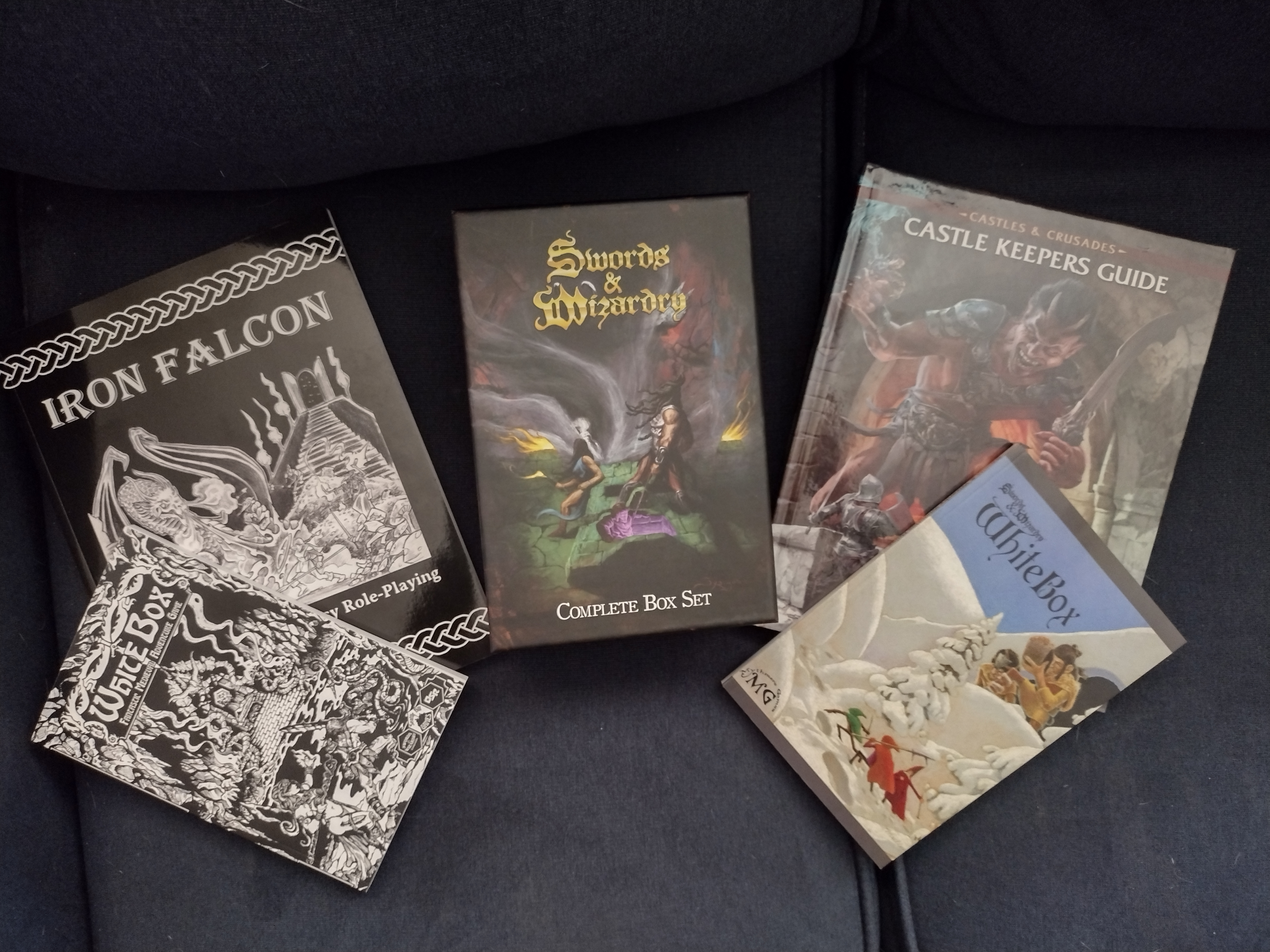
These are a few of my favorite tabletop RPGs and I realize that not all of them are OD&D clones but that’s not a big deal. Let me introduce you. Yes, you can find Original D&D in the form of PDF and then either have them printed yourself and there are dozens of tutorials or have someone do it for you and just pay them but, before you do, I would also reduce barriers to entry first.
Swords & Wizardry White Box Rules is a $2 PDF and also comes in print on Lulu.com for roughly about $10. It’s aimed at capturing the intention of the original white box rules in one book while cleaning up and making sure they’re a little more clear. There’s also a core rulebook that is available as a free PDF on Lulu and many other sites as well.
White Box: Fantastic Medieval Adventure Game is available as a free PDF or for less than $5 on Amazon and this one is by Charlie Mason who wanted a slightly updated version of Swords & Wizardry White Box Rules. This was actually the first book that I bought when I was looking into old school D&D and this one comes in three different covers. I happen to like the Black And White wraparound cover best as I think it accurately reflects that badass old school feel. Mechanically it’s almost identical to Swords & Wizardry White Box Rules but I think, if memory serves, the Thief class is expanded a bit. You can also have a look at the website if you want to see all three covers and select one from there.
The Swords & Wizardry Complete Box Set is one that is no longer in print but really does a good job of taking it back to the box, so to speak. Same rules, classes, and mechanics albeit cleaned up and updated and the artwork is in full color. Mine came with a GM screen and a couple of extra books and even with all of that, I was still able to slip my copy of Skate Wizards in there, which is another game you should check out because it’s a hell of a lot of fun and it may not be OD&D but it’s still a fun, laugh-a-minute game that you and your friends will definitely enjoy, I highly recommend it.
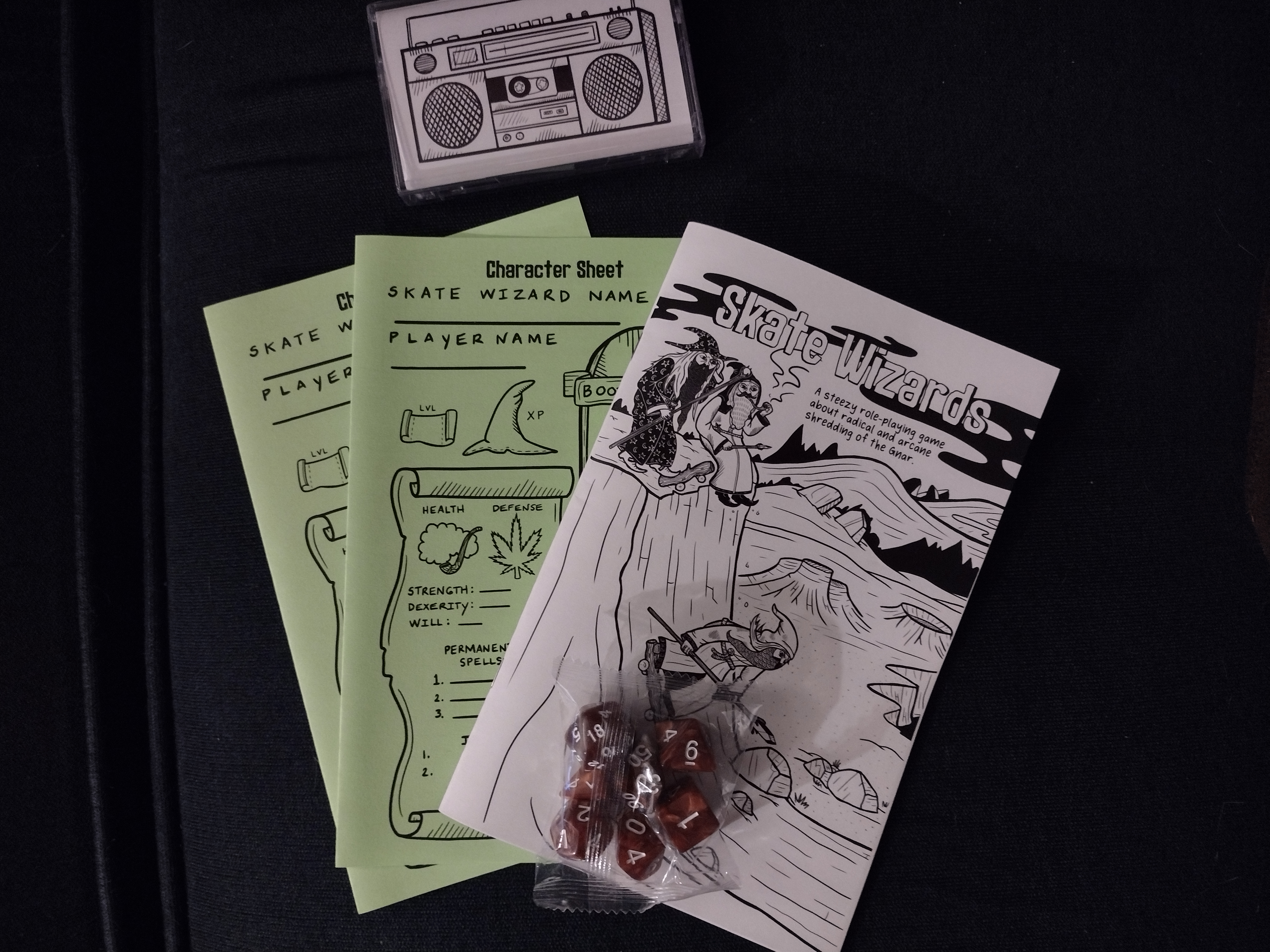
Pictured: Wizards & Skateboards & Posers, Oh Dude!!!
Seriously, grab this game for $35 shipped and have some fun at the table. I don’t think you’ll regret it in the least and yes, that’s an audiocassette from Loot The Body with music on it for the game that’s actually pretty enjoyable.
Back to the OD&D clones, Iron Falcon by Chris Gonnerman is one that isn’t a 1:1 clone of the OD&D rules but the rules as Gonnerman, himself would have played them. What you’re looking at differs from others in that this particular rule set is basically the OD&D rules, house-ruled by Gonnerman so you can follow his suggestions as to how he would have played them as an example or you can choose to ignore his suggestions and find your own playstyle. It also includes some Greyhawk in there, hence the name Iron Falcon. There’s also Iron Falcon: Handbook of Monsters, Iron Falcon ‘75 where you play people living in 1975 with the world of Iron Falcon suddenly thrust into your own world. How do you and your buds rocking your conversion van handle the sudden intrusion of mythical monsters and magic in your world? Well, that’s for you to decide and then, there’s Iron Falcon Adventures Vol. 1 which doesn’t have a volume two yet but who knows what the future holds?
The final book in the photo above that you saw was the Castles & Crusades Castle Keeper’s Guide which is a more modern game and picks up kinda where AD&D second edition left off, however, my suggestion at sharing the wisdom of OD&D and a few of it’s indie clones is to take the lessons learned from OD&D into your more modern game and adjust as needed. Your own skills as a Dungeon Master, Game Master, Castle Keeper, Referee, Judge, whatever you call yourself will be improved in some way, shape or form by the experience of spreading your wings a little more, flying a little closer to the sun and simply going where eagles dare. If it doesn’t, then you’re no worse off than where you started.
Also, Castles & Crusades also has a White Box Set that does something similar to the Castles & Crusades game, taking it down to a stripped down version of their three core books. I haven’t seen the contents of this box, but I can assure you that the boys at Troll Lord Games have written it in such a way that the answers to any questions are going to be, “What would you do? Then that’s the right way.”
Also, I’d like you to take those skills into your future game of Wasted Lands: The Dreaming Age, a new, unique take on the Sword & Sorcery Genre which, if it reaches $20k, will receive a conversion guide to the SIEGE Engine which Castles & Crusades uses or you could even use OD&D Rules, d20, d6, or whatever rule set you feel might be more in line with your game mastering skill level. Hit that button below and pledge and why not pick up a few of the free PDFs while you’re at it. Challenge your skill level and level up today. Thanks for reading!
 The Ravens Nest
Leave a comment